
Enterprise Hiring in 2026: What Actually Works for Scaling Teams
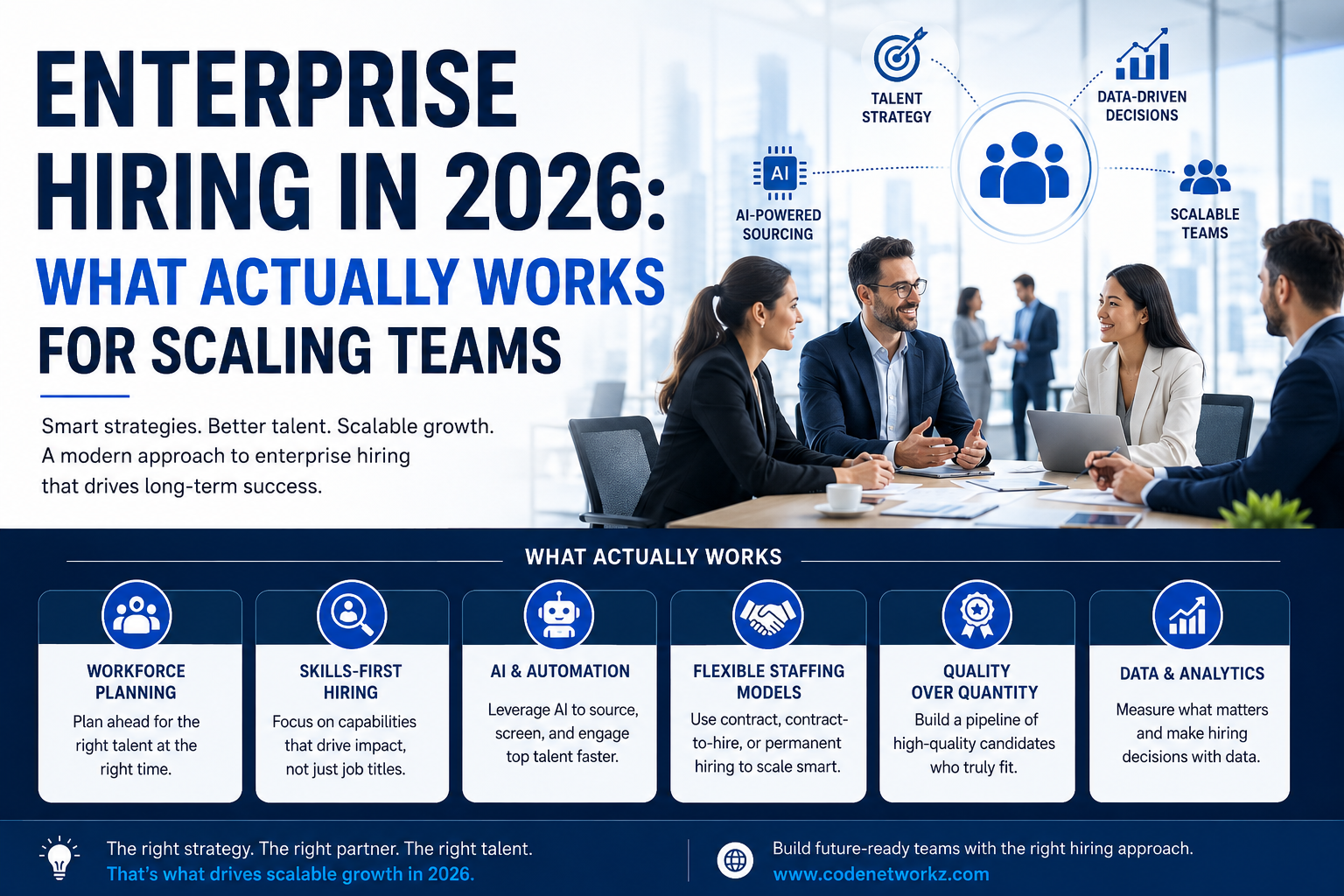
Enterprise Hiring in 2026: What Actually Works for Scaling Teams
Enterprise Hiring in 2026: What Actually Works for Scaling Teams
Hiring is no longer just about filling open positions. In 2026, enterprise hiring is about building teams that can scale, adapt, and deliver results without sacrificing quality.
A company can have a strong product, a large customer base, and a healthy budget, but growth can still slow down when the right talent isn't available at the right time.
That is the challenge many enterprises face today.
Hiring one or two employees may be relatively straightforward. But hiring dozens or hundreds of professionals across technology, finance, operations, healthcare, cybersecurity, data, and other specialized areas requires a completely different approach.
The question is no longer, "How quickly can we hire?"
The better question is:
"How can we scale hiring without compromising candidate quality, employee fit, compliance, or business goals?"
In 2026, the companies answering that question effectively are combining workforce planning, specialized recruiting, technology, data-driven decision-making, and human expertise.
This guide explores what actually works for enterprise hiring in 2026 and how organizations can build a scalable recruitment strategy.
What Is Enterprise Hiring?
Enterprise hiring refers to the process of recruiting employees at scale for large organizations with complex workforce requirements.
Unlike small-business recruitment, enterprise hiring often involves:
- Multiple departments
- Large candidate pipelines
- Specialized technical roles
- Multiple geographic locations
- Complex approval processes
- Compliance requirements
- Structured interview processes
- High-volume recruitment
- Contract and permanent hiring
- Workforce planning
- Multiple stakeholders
An enterprise may need to hire software engineers, cloud specialists, cybersecurity professionals, project managers, business analysts, data scientists, finance professionals, and other specialists at the same time.
This creates a major challenge: how do you maintain hiring speed while keeping quality consistent?
Why Enterprise Hiring Is Changing in 2026
The workforce has become more specialized, competitive, and technology-driven.
Organizations are dealing with changing technology requirements, evolving employee expectations, skills shortages, and pressure to control recruitment costs.
At the same time, artificial intelligence is changing how recruiters source and evaluate candidates.
AI can help automate repetitive recruitment tasks, identify potential candidate matches, analyze large talent pools, and improve workflow efficiency. But technology alone doesn't solve enterprise hiring challenges.
The companies that perform best are likely to combine automation with human decision-making.
That means recruiters still need to understand candidates, hiring managers still need to evaluate business fit, and organizations still need clear workforce strategies.
1. Start With Workforce Planning, Not Job Posting
One of the biggest mistakes enterprises can make is starting recruitment only after a position becomes urgent.
If a business knows it will need 50 cloud engineers over the next six months, waiting until projects are already underway can create unnecessary pressure.
Effective enterprise hiring starts with workforce planning.
Organizations should identify:
- Current workforce capacity
- Future hiring requirements
- Critical skill gaps
- Expected employee turnover
- Upcoming projects
- Business expansion plans
- Technology changes
- Location requirements
- Contract versus permanent workforce needs
Instead of asking, "Who do we need today?", enterprise hiring teams should also ask:
"What capabilities will we need three, six, or twelve months from now?"
This approach allows recruiters to build talent pipelines before positions become urgent.
2. Build Talent Pipelines Before You Need Them
A talent pipeline is a pool of potential candidates who could be considered for current or future positions.
This is particularly valuable for highly specialized technology roles.
For example, if an organization regularly hires:
- Software engineers
- DevOps engineers
- Cloud architects
- Data engineers
- Cybersecurity professionals
- SAP consultants
- AI specialists
it should not start sourcing candidates from zero every time a vacancy appears.
Recruiters can maintain relationships with qualified professionals and keep candidate information organized.
When a new requirement opens, the organization can activate an existing talent pipeline rather than beginning the entire sourcing process again.
The best time to build a talent pipeline is before the hiring emergency starts.
3. Focus on Skills, Not Just Job Titles
Traditional recruitment often begins with job titles.
But job titles can be misleading.
Two companies may use the same title while expecting completely different responsibilities.
For example, a "Software Engineer" at one enterprise may primarily work with Java and Spring Boot, while another company may require React, Node.js, cloud infrastructure, and DevOps experience.
Enterprise hiring should therefore focus on skills and capabilities.
A strong job profile should clearly identify:
- Essential technical skills
- Preferred skills
- Relevant experience
- Industry knowledge
- Certifications where necessary
- Communication requirements
- Leadership expectations
- Business responsibilities
Skills-based hiring can also help organizations identify candidates who may not have the exact job title but possess the capabilities required for success.
4. Use AI to Improve Recruitment Efficiency
AI is one of the biggest changes in modern recruitment.
Recruitment teams can use AI-supported tools for activities such as:
- Candidate sourcing
- Resume screening
- Candidate matching
- Job description creation
- Recruitment analytics
- Interview scheduling
- Candidate communication
- Talent-pool management
However, enterprise organizations should avoid treating AI as a replacement for recruiters.
AI can identify patterns and matches, but recruitment also requires judgment.
A candidate may have every required keyword on a resume but lack the communication skills, project experience, motivation, or business understanding required for the position.
The strongest approach is:
AI for efficiency + recruiters for judgment + hiring managers for business decisions.
This combination can help enterprise teams move faster without turning recruitment into an entirely automated process.
5. Improve Candidate Screening
Enterprise hiring can generate large volumes of applications.
The challenge isn't simply finding candidates. It's identifying the candidates worth moving forward.
A structured screening process should evaluate candidates against clearly defined criteria.
Depending on the position, screening may consider:
- Technical knowledge
- Relevant work experience
- Project experience
- Industry exposure
- Communication skills
- Certifications
- Availability
- Location
- Work authorization requirements
- Compensation expectations
- Career objectives
For technology positions, recruiters should have enough technical understanding to distinguish between superficial keyword matches and genuinely relevant experience.
Specialized IT staffing recruiters can be particularly valuable for enterprise technology hiring because they understand the difference between related but distinct technical skill sets.
6. Reduce Time-to-Hire Without Sacrificing Quality
A slow recruitment process can cause companies to lose strong candidates.
Imagine a highly qualified technology professional receives three offers while an enterprise is still completing its third interview round.
By the time the organization makes an offer, the candidate may already have accepted another opportunity.
Enterprise hiring teams should therefore examine every stage of their hiring process.
Look for delays in:
- Resume review
- Candidate submission
- Interview scheduling
- Hiring manager feedback
- Interview approvals
- Offer approvals
- Background checks
- Onboarding
Reducing unnecessary delays doesn't mean lowering hiring standards.
It means removing unnecessary friction.
A well-designed recruitment workflow can help hiring teams make decisions faster while maintaining structured evaluation.
7. Create a Better Candidate Experience
Candidates evaluate companies just as companies evaluate candidates.
A confusing or slow hiring experience can damage an employer's reputation and cause strong candidates to withdraw.
Enterprise organizations should communicate clearly about:
- Job responsibilities
- Interview stages
- Expected timelines
- Compensation ranges where appropriate
- Work arrangements
- Required skills
- Next steps
Candidates should not have to repeatedly ask what happens next.
Recruiters can play a central role by keeping candidates informed throughout the process.
A simple message explaining that an interview is delayed can make a significant difference compared with leaving a candidate without an update.
8. Use Flexible Staffing Models
Not every business requirement needs a permanent employee.
Enterprise organizations often need different workforce models depending on the project.
Contract Staffing
Contract professionals can support organizations for defined periods or specific business requirements.
This can be useful for project-based work, temporary capacity requirements, or specialized skill gaps.
Contract-to-Hire
Contract-to-hire arrangements can provide organizations with flexibility while allowing both the employer and professional to evaluate long-term fit.
Permanent Staffing
Permanent hiring is appropriate when an organization needs long-term employees who can grow with the business.
Project-Based Staffing
Specialized professionals can be brought in for implementations, migrations, technology upgrades, transformation programs, or other projects.
Using multiple staffing models allows enterprises to create a workforce strategy based on actual business requirements rather than applying one hiring model to every position.
9. Strengthen Recruitment Compliance
Enterprise recruitment often involves more complexity than simply finding candidates.
Organizations may need to manage requirements related to:
- Employment eligibility
- Background verification
- Data privacy
- Equal employment practices
- Contract documentation
- Worker classification
- Industry-specific regulations
- Client-specific compliance requirements
A scalable recruitment process should build compliance into the workflow instead of treating it as an afterthought.
This is especially important when organizations work across multiple locations or use different staffing models.
A structured staffing partner can help enterprises maintain consistent recruitment processes and documentation across large hiring programs.
10. Measure What Actually Matters
Enterprise recruitment should be measurable.
However, organizations shouldn't focus only on the number of resumes submitted.
Important recruitment metrics can include:
Time-to-Hire
How long does it take to move from an approved requirement to an accepted offer?
Time-to-Fill
How long does it take to fill an open position?
Submission-to-Interview Ratio
How many candidate submissions result in interviews?
Interview-to-Offer Ratio
How many interviews lead to offers?
Offer Acceptance Rate
How many candidates accept offers?
Quality of Hire
Do new employees meet performance expectations?
Retention
Do employees stay with the organization?
These metrics help organizations understand where recruitment processes are working and where improvements are needed.
11. Build Strong Partnerships With Specialized Recruiters
Internal recruitment teams are valuable, but they may not always have enough capacity or specialized expertise to handle every hiring requirement.
This is where staffing and recruitment partners can provide additional support.
A specialized staffing partner can help with:
- Candidate sourcing
- Technical recruitment
- Candidate screening
- Talent pipeline development
- High-volume hiring
- Contract staffing
- Contract-to-hire staffing
- Permanent recruitment
- Recruitment process support
For enterprises, the value isn't simply having someone send resumes.
The real value comes from having a recruitment partner that understands the business requirement and can consistently deliver relevant candidates.
12. Make Hiring Managers Part of the Process
Recruitment isn't solely an HR responsibility.
Hiring managers have an important role in defining what success looks like.
Before recruitment begins, recruiters and hiring managers should agree on:
- Required skills
- Preferred skills
- Experience level
- Responsibilities
- Interview criteria
- Compensation expectations
- Hiring timeline
- Candidate priorities
This alignment reduces confusion later.
It also helps recruiters understand what the hiring manager actually needs rather than relying on a generic job description.
What Enterprise Hiring Will Look Like Going Forward
The future of enterprise recruitment isn't simply about hiring more people.
It's about building a repeatable system for finding and retaining the right talent.
Organizations that want to scale successfully will need to combine:
Workforce planning
- Skills-based hiring
- AI-enabled recruitment
- Specialized recruiters
- Flexible staffing models
- Structured screening
- Strong candidate experience
- Data-driven decision-making
This creates a recruitment ecosystem that can adapt as business needs change.
Common Enterprise Hiring Mistakes to Avoid
Even large organizations can make basic recruitment mistakes.
Hiring Only When Positions Become Urgent
This creates unnecessary pressure and reduces the available talent pool.
Relying Only on Job Boards
Not every qualified professional is actively applying to job advertisements.
Using Generic Job Descriptions
Vague requirements attract large numbers of irrelevant applications.
Ignoring Candidate Experience
Long delays and poor communication can cause qualified candidates to leave the process.
Measuring Resume Volume Instead of Hiring Quality
More resumes do not automatically mean better recruitment.
Treating AI as a Complete Replacement for Recruiters
Technology can improve efficiency, but human judgment remains important.
Failing to Align Recruiters and Hiring Managers
Poor communication at the beginning often creates problems throughout the hiring process.
How CodeNetworkz Can Support Enterprise Hiring
For organizations managing complex technology hiring requirements, the right staffing partner can make scaling easier.
CodeNetworkz focuses on enterprise technology staffing and talent solutions designed to help organizations connect with qualified professionals across specialized technology requirements.
A structured approach can support organizations with contract staffing, contract-to-hire staffing, and permanent hiring, depending on business needs.
For enterprises, the objective should not be simply to increase the number of candidates entering the recruitment pipeline.
It should be to create a recruitment process that consistently delivers qualified talent, faster decisions, flexible workforce options, and stronger long-term hiring outcomes.
Final Thoughts
Enterprise hiring in 2026 is becoming less about traditional recruitment and more about building a scalable talent strategy.
Companies that continue relying on slow processes, generic job descriptions, disconnected recruiting teams, and reactive hiring may struggle as competition for specialized talent increases.
The organizations that succeed will build talent pipelines early, focus on skills, use AI intelligently, improve candidate experience, measure recruitment performance, and work with specialized staffing partners when additional expertise or capacity is required.
Most importantly, enterprise hiring should be treated as a business function—not simply an HR task.
When the right people are hired at the right time, with the right skills, business growth becomes easier to scale.
That's what effective enterprise hiring should accomplish in 2026.