
What Is a Staffing Recruiter? Roles, Skills & Hiring Process Explained
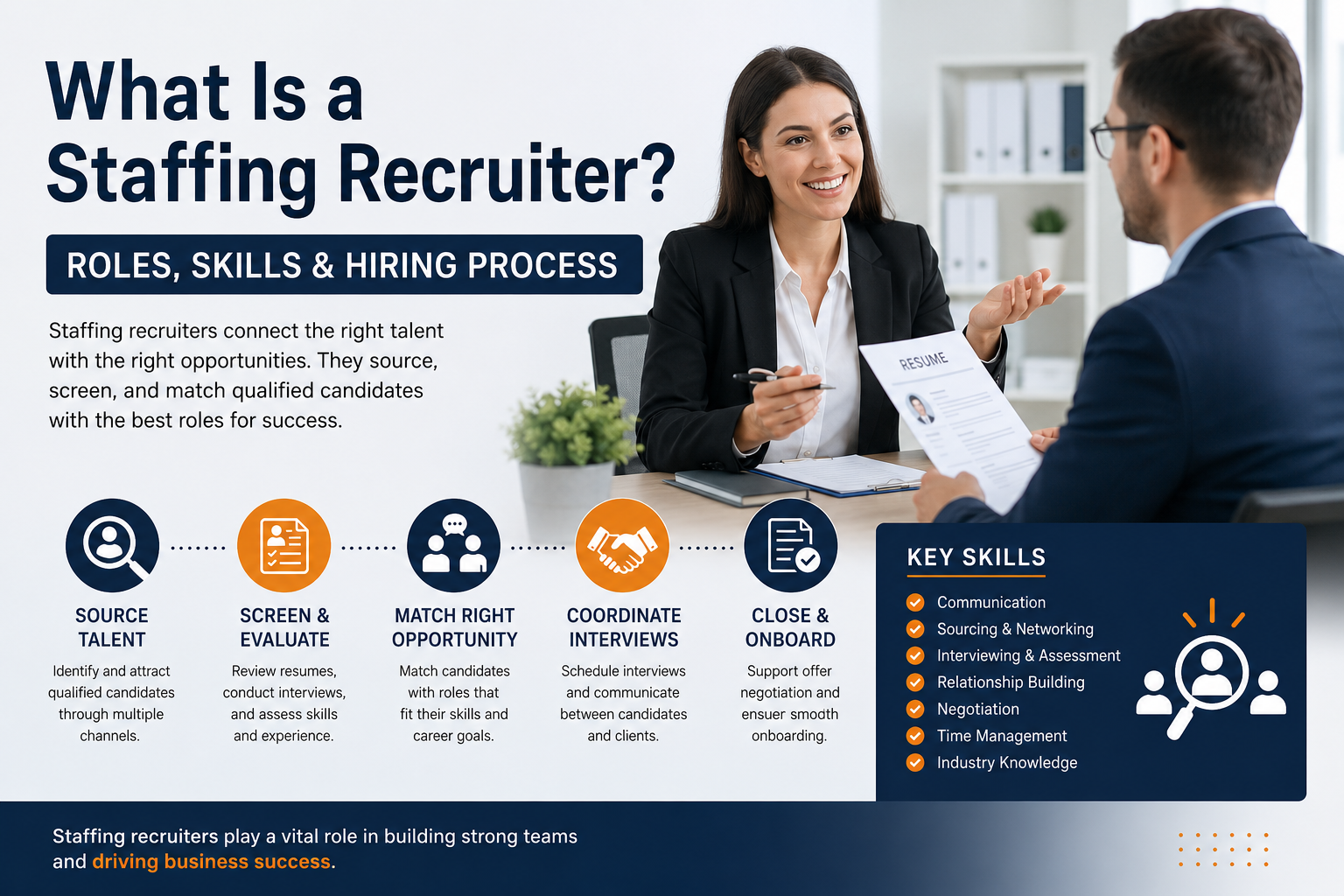
What Is a Staffing Recruiter? Roles, Skills & Hiring Process Explained
What Is a Staffing Recruiter? Roles, Skills, and Hiring Process
Hiring the right person is rarely as simple as posting a job and waiting for applications.
A company may receive hundreds of resumes and still struggle to find one candidate with the right skills, experience, availability, and expectations. At the same time, qualified professionals can apply to dozens of jobs without ever reaching the right hiring manager.
This is where a staffing recruiter makes a difference.
A staffing recruiter connects employers with qualified candidates, manages the recruitment pipeline, screens applicants, coordinates interviews, and helps move the hiring process toward a successful placement. In fast-moving industries such as technology, healthcare, finance, and enterprise services, staffing recruiters can help organizations access talent faster while reducing the workload on internal hiring teams.
But what exactly does a staffing recruiter do? What skills do they need? How does the staffing recruitment process work? And how is a staffing recruiter different from a traditional recruiter or talent acquisition specialist?
Let's break it down.
What Is a Staffing Recruiter?
A staffing recruiter is a recruitment professional who helps organizations find, evaluate, and hire candidates for open positions.
Staffing recruiters commonly work for staffing agencies, recruitment firms, or specialized workforce solution providers. Unlike recruiters who may focus exclusively on internal hiring for one company, staffing recruiters often support multiple clients and job openings.
Their responsibilities can include:
- Understanding client hiring requirements
- Searching for qualified candidates
- Reviewing resumes and applications
- Conducting initial candidate screening
- Evaluating skills and experience
- Coordinating interviews
- Managing candidate communication
- Collecting interview feedback
- Supporting offer negotiations
- Assisting with onboarding and joining
- Maintaining candidate pipelines
- Building long-term relationships with candidates and employers
In simple terms, a staffing recruiter helps close the gap between a company that needs talent and a professional who is looking for the right opportunity.
The role becomes particularly valuable when an organization has urgent hiring needs, multiple vacancies, specialized technology requirements, or limited internal recruiting resources.
Why Staffing Recruiters Matter in Modern Hiring
The hiring market has changed significantly.
Companies are no longer competing only for candidates who actively apply to job postings. Recruiters increasingly search for passive candidates, specialized professionals, and talent through professional networks and candidate databases.
For technology companies, this challenge is even greater. A single position may require a combination of specific technical skills, industry experience, certifications, location requirements, and project experience.
For example, an employer may not simply need a software developer. It may need a developer with:
- 5+ years of experience
- Java and Spring Boot expertise
- Cloud experience
- Microservices knowledge
- Enterprise application experience
- Strong communication skills
- Immediate or short-term availability
Finding that combination requires more than posting a vacancy.
A skilled staffing recruiter understands the requirement, searches the right talent pools, evaluates candidates, and keeps qualified professionals engaged throughout the process.
What Does a Staffing Recruiter Do?
A staffing recruiter typically manages several stages of the recruitment lifecycle.
1. Understand the Hiring Requirement
The process begins with understanding what the employer actually needs.
The recruiter may discuss:
- Job responsibilities
- Required qualifications
- Technical skills
- Years of experience
- Industry background
- Location
- Remote or hybrid requirements
- Compensation range
- Availability
- Contract duration
- Hiring timeline
This step is important because a poorly understood requirement can lead to irrelevant candidates and wasted interview time.
A good recruiter doesn't simply copy a job description. They ask questions and clarify what makes a candidate successful in the position.
2. Source Qualified Candidates
Once the requirement is clear, the recruiter begins candidate sourcing.
Depending on the position, recruiters may use:
- Professional networking platforms
- Job boards
- Candidate databases
- Employee referrals
- Recruiter networks
- Social media
- Professional communities
- Existing talent pools
- Direct outreach
Modern recruiters may also use AI-assisted sourcing and matching technologies to identify relevant candidates more efficiently. AI is increasingly being used in recruiting for sourcing, screening, and candidate matching, while human recruiters remain important for relationship-building and judgment.
3. Screen Candidates
Finding candidates is only the beginning.
A staffing recruiter must determine whether a candidate actually fits the position.
Initial screening may evaluate:
- Technical skills
- Relevant experience
- Education or certifications
- Previous projects
- Communication skills
- Location
- Work authorization where applicable
- Compensation expectations
- Availability
- Career goals
- Interest in the position
The recruiter may conduct a phone or video interview to verify information that may not be apparent from a resume.
4. Shortlist and Submit Candidates
After screening, the recruiter identifies the strongest candidates.
For staffing clients, the goal isn't necessarily to send the most resumes. The goal is to send relevant, qualified, and interview-ready candidates.
A strong shortlist can save hiring managers significant time.
5. Coordinate Interviews
The recruiter often acts as the communication bridge between the candidate and employer.
Responsibilities can include:
- Scheduling interviews
- Confirming availability
- Sharing interview details
- Preparing candidates
- Communicating changes
- Collecting feedback
- Coordinating additional interview rounds
This coordination can become especially important when several candidates are moving through the process simultaneously.
6. Manage Candidate Engagement
Candidates can disappear from a hiring process for many reasons.
They may receive another offer, lose interest, accept a counteroffer, or become frustrated by long delays.
A staffing recruiter helps maintain communication throughout the process.
Regular updates can improve the candidate experience and reduce avoidable drop-offs.
7. Support Offer and Onboarding
The recruiter's work doesn't always end when the interview ends.
Staffing recruiters may assist with:
- Offer communication
- Compensation discussions
- Documentation
- Background checks
- Joining dates
- Notice-period coordination
- Onboarding
- Post-placement follow-up
The exact responsibilities depend on the employer, staffing model, and organization.
The Staffing Recruitment Process: Step by Step
So, how does a staffing recruiter actually move a vacancy from an open requirement to a successful hire?
A typical process looks like this:
Requirement → Sourcing → Screening → Shortlisting → Interview → Feedback → Offer → Onboarding → Follow-up
Step 1: Requirement Intake
The recruiter understands the employer's business need and defines the candidate profile.
Step 2: Talent Sourcing
Potential candidates are identified through multiple sourcing channels.
Step 3: Initial Screening
Candidates are evaluated against the core job requirements.
Step 4: Candidate Validation
Relevant experience, skills, availability, expectations, and other job-related details are confirmed.
Step 5: Candidate Submission
Qualified candidates are presented to the hiring organization.
Step 6: Interview Coordination
The recruiter schedules interviews and keeps communication moving.
Step 7: Feedback and Evaluation
The recruiter and hiring team exchange feedback and determine next steps.
Step 8: Offer Management
The selected candidate moves toward an offer and acceptance.
Step 9: Onboarding
Documentation, background checks, joining requirements, and onboarding activities are completed as applicable.
Step 10: Post-Placement Support
The recruiter may continue communication with both the candidate and client to ensure a smooth transition.
This structured approach helps reduce hiring friction and gives both employers and candidates a clearer path through recruitment.
What Skills Does a Staffing Recruiter Need?
Being a successful staffing recruiter requires more than knowing how to search resumes.
1. Communication Skills
Recruiters communicate with candidates, hiring managers, HR teams, and clients every day.
Clear emails, effective phone conversations, active listening, and professional follow-up are essential.
2. Candidate Sourcing Skills
A strong recruiter knows where to find relevant talent and how to approach professionals who may not be actively looking for jobs.
3. Screening and Evaluation
Recruiters need to distinguish between a candidate who simply matches keywords and someone who genuinely fits the role.
4. Relationship Building
Recruitment is relationship-driven.
A recruiter may work with the same candidate or client multiple times over several years. Building trust can create a stronger talent network and better hiring outcomes.
5. Time Management
Staffing recruiters may manage multiple job openings and dozens of candidates at once.
Prioritizing urgent requirements, interviews, follow-ups, and submissions is critical.
6. Negotiation Skills
Recruiters may help manage conversations around compensation, availability, job expectations, and offers.
7. Technology Skills
Modern staffing recruiters frequently work with:
- Applicant Tracking Systems
- Candidate databases
- Recruitment platforms
- LinkedIn and professional networks
- Video interviewing tools
- Analytics dashboards
- AI recruitment tools
8. Industry Knowledge
Recruiting for a software engineer is different from recruiting for a financial analyst, healthcare IT professional, cloud engineer, or SAP consultant.
The more familiar a recruiter is with the industry and job requirements, the better they can evaluate candidates.
9. Adaptability
Hiring requirements can change quickly.
A position may suddenly become remote, require a different technology, change its seniority level, or need to be filled immediately.
Good recruiters adapt without losing focus on quality.
Staffing Recruiter vs. Recruiter vs. Talent Acquisition Specialist
These terms are sometimes used interchangeably, but there are differences.
RolePrimary FocusTypical Environment
Staffing Recruiter | Filling client roles and managing candidate pipelines | Staffing firms and recruitment agencies
Recruiter | Sourcing and hiring candidates | Internal or external recruitment
Talent Acquisition Specialist | Broader hiring strategy and talent planning | Internal corporate HR/TA teams
Recruitment Consultant | Recruitment plus client advisory support | Recruitment agencies and consulting firms
The exact responsibilities can vary from one company to another.
A staffing recruiter is generally more delivery-focused, especially when the organization needs candidates quickly or has multiple positions to fill.
Staffing Recruiters and IT Hiring
Technology hiring is one area where specialized staffing recruiters can provide significant value.
Technology roles often require knowledge of specific skills and platforms such as:
- Artificial Intelligence
- Machine Learning
- Data Science
- Cloud Computing
- Cybersecurity
- DevOps
- Software Development
- SAP
- Oracle
- Salesforce
- Data Engineering
- Infrastructure
- Mobile Application Development
For example, an employer hiring an AWS Cloud Engineer may need someone who understands cloud architecture, DevOps tools, security practices, automation, and enterprise infrastructure.
A recruiter who understands these requirements can conduct a more meaningful first-level evaluation than someone relying only on job-title matching.
Common Staffing Models
Staffing recruiters may support several hiring models.
Contract Staffing
A professional is hired for a defined period or project.
Contract staffing can be useful when companies need specialized skills without committing to a long-term permanent position.
Contract-to-Hire
The candidate initially works under a contract arrangement, with the possibility of transitioning to permanent employment based on the employer's requirements and applicable terms.
Permanent Staffing
The candidate is hired for a long-term position with the organization.
Project-Based Staffing
Organizations can bring in specialized professionals for specific projects, implementations, migrations, or business initiatives.
The right model depends on project duration, workforce requirements, budget, business strategy, and long-term hiring plans.
How AI Is Changing the Staffing Recruiter Role
AI is changing recruitment, but it does not eliminate the need for recruiters.
AI can help recruiters:
- Search large talent pools
- Identify potential candidate matches
- Analyze resumes
- Automate repetitive tasks
- Improve sourcing efficiency
- Organize candidate information
- Support candidate matching
- Generate recruitment insights
However, recruitment still involves human decisions.
A system may identify candidates with matching skills, but a recruiter must understand whether the candidate is genuinely interested, communicate the opportunity clearly, build trust, manage expectations, and coordinate with the hiring organization.
This means the modern staffing recruiter is becoming less focused on repetitive administrative work and more focused on judgment, relationships, communication, and hiring strategy.
How Staffing Recruiters Help Employers
For employers, working with a staffing recruiter can provide several advantages.
Faster Access to Talent
Staffing firms often maintain candidate networks and talent pools that can be activated when new requirements appear.
Reduced Recruitment Workload
Recruiters can manage sourcing, initial screening, coordination, and follow-ups, allowing internal teams to focus on higher-value activities.
Specialized Hiring Expertise
Specialized recruiters can understand specific technologies, industries, and job requirements.
Flexible Hiring
Companies can choose staffing models that align with their workforce requirements, including contract, contract-to-hire, permanent, and project-based hiring.
Better Candidate Pipeline Management
A structured recruitment process helps organizations maintain visibility across candidates and hiring stages.
How Candidates Can Work Effectively With Staffing Recruiters
Candidates can also benefit from building professional relationships with recruiters.
Keep your resume updated and make sure it clearly communicates your relevant skills and experience.
Maintain a professional online profile and highlight specialized skills rather than only generic job titles.
When a recruiter contacts you:
- Respond professionally.
- Confirm your interest.
- Ask questions about the position.
- Be honest about your experience.
- Clarify your availability.
- Share an updated resume when appropriate.
- Follow up after interviews.
- Keep recruiters informed when your circumstances change.
You don't need to work with every recruiter. Focus on building relationships with recruiters who understand your industry and career goals.
What Makes a Good Staffing Recruiter?
A good staffing recruiter isn't simply the person who sends the most resumes.
A strong recruiter understands the right candidate, the right role, and the right timing.
They listen carefully to employers.
They understand what candidates actually want.
They communicate clearly.
They screen candidates honestly.
They follow up consistently.
They understand the market.
And they know that a successful placement isn't just about filling a vacancy. It's about creating a match that works for both the organization and the professional.
Final Thoughts
A staffing recruiter plays a critical role in today's competitive hiring environment.
From understanding job requirements and sourcing candidates to screening, interviewing, coordinating, negotiating, and supporting onboarding, staffing recruiters help keep the hiring process moving.
For employers, they can provide faster access to qualified talent, specialized recruitment knowledge, flexible staffing models, and additional hiring capacity.
For candidates, a strong staffing recruiter can provide access to opportunities that may not always be visible through public job boards.
And as recruitment technology continues to evolve, the most effective recruiters will combine AI-powered efficiency with human judgment and relationship-building.
The future of staffing isn't simply about finding more candidates.
It's about finding the right candidate faster, evaluating fit more intelligently, and creating a hiring experience that works for everyone involved.
For organizations hiring technology professionals, a specialized staffing partner can make that difference by combining industry knowledge, structured screening, flexible hiring models, and a disciplined recruitment process.